




In recent years the word labyrinth has developed a meaning distinct from the word maze. Mazes are multicursal, replete with paths that branch, forcing the wanderer to make choices. Labyrinths, instead, are unicursal: long, winding paths with no branches and thus no choices. Such labyrinths are now used for rituals and meditation. Walking a labyrinth can bring a sense of peace.
 Both meanings stem from the ancient Labyrinth of Crete, built by Daedalus to house the dreaded Minotaur. Although this structure was clearly a maze, so full of bewildering choices that no
escape was possible without the use of Ariadne's thread, it was often represented in coins or pottery with the unicursal design shown at right. The distinction raises questions about free will;
are the choice we make in life our own, or is our fate sealed from the outset?
Both meanings stem from the ancient Labyrinth of Crete, built by Daedalus to house the dreaded Minotaur. Although this structure was clearly a maze, so full of bewildering choices that no
escape was possible without the use of Ariadne's thread, it was often represented in coins or pottery with the unicursal design shown at right. The distinction raises questions about free will;
are the choice we make in life our own, or is our fate sealed from the outset?
The starmaze is, of course, a maze. But would it be possible to build a labyrinth on the framework of the starmaze? Keep the nine cells of circles and squares, keep the hypercube and the one-way edges, but change the rules that determine how movement controls which shapes are open and which are closed, so that each room would only have a single exit?
The starmaze has something like this already: the Grand Tour , which suspends normal movement restrictions and visits each room exactly once in one continuous path. But to follow this path you have to ignore the marked entrances and exits. Could we change the rules to create a true labyrinth?
In my page on Puzzle Keys I developed a way to talk about such variations across a class of structures called hypercube puzzles. Hypercube puzzles are built on rooms mapped to the corners of a hypercube with exits and entrances defined by one way edges between those corners. The rules of each puzzle are solely determined by the direction of its edges. Change the direction of any of the 2304 edges of the classic starmaze puzzle, and you change its behavior.
In a 2D puzzle - a square - it is indeed possible to create a labyrinth. Arrange the edge directions to form a cycle, either clockwise or counterclockwise, and you form a continuous path visiting all four rooms with no branches.
But when we move to a 3D puzzle - a cube - we run into a problem.
To form a labyrinth that encompasses the entire hypercube we first need a path that visits each room exactly once, returning to its starting point: a grand tour.
To create a 3-dimensional grand tour, move 3/4ths of the way around a bottom face, move up, then move backwards 3/4ths along the top face. You can then move down to finish the 3D cycle, OR move out to the outer cube of a tesseract and then repeat that cube pattern to create a 4-dimensional tour. You can continue this pattern indefinitely, repeating a 4-tour to create a 5-tour, repeating a 5-tour to create a 6-tour, etc. No matter how high you go, the final room is always adjacent to the origin. This fractal-like pattern of flipping one bit at a time to visit all possible positions is also known as a Gray code.
An n-dimensional grand tour always has 2^n steps - which makes sense since it visits 2^n rooms. So a cubic grand tour will traverse 8 edges. But here's the problem: a cube has 12 edges, not 8. How do we orient the remaining 4 unused edges?
If we want each room to only have a single exit, we should point the unused edges extending from each room inward to form entrances. But each entrance we create causes an unwanted exit in the room on the other side of that edge, an exit leading back and forming an unwanted cycle. No matter how you point them, unwanted edges always create unwanted branches - there is no escape from this.
The problem only gets worse in higher dimensions. The number of edges in an n-cube is n*2^(n-1), a number that grows faster than the number of corners. So, except for the 2-cube, labyrinths are not possible on the surface of a hypercube.
| Dimension | Total Edges | Unused Edges | Percentage Unused |
|---|---|---|---|
| 2 | 4 | 0 | 0.00% |
| 3 | 12 | 4 | 33.33% |
| 4 | 32 | 16 | 50.00% |
| 5 | 80 | 48 | 60.00% |
| 6 | 192 | 128 | 66.67% |
| 7 | 448 | 320 | 71.43% |
| 8 | 1024 | 768 | 75.00% |
| 9 | 2304 | 1792 | 77.78% |
So if we cannot form a true unicursal labyrinth that encompasses the entire hypercube, could we settle for a shorter labyrinth that leaves some rooms outside the main path? And if so, how long could we make it?
In 3 dimensions, if you orient your edges in just the right way, you can make a 6-step labyrinth. Only 6 corners are included in the path; the other two are both disconnected source rooms that have only exits. Because you can take the three dimensons, width, height, and depth, in any order, there are six different ways of forming the same cycle:

Unlike the grand tour, this design cannot be recursively extended into higher dimensions. With each new dimension we have to start over and find a new labyrinth, and finding these paths is suprisingly hard. Every time you add a new room to the path, you must close the doors to all but one adjoining rooms, making those other rooms unfit for future inclusion. The more dimensions you have, the more complex this problem becomes.
Mathematicians refer to labyrinths inside hypercubes as induced chordless cycles or coils. Finding the longest possible coil in a n-dimensional hypercube is called the coil in the box problem and is computationally difficult (NP-hard). The maximum known lengths (as of 2026) are as follows:
Dimension
Longest Labyrinth
2
4
3
6
4
8
5
14
6
26
7
48
8
96
9
>= 188
So we cannot have a true labyrinth in nine dimensions, but we could form about a third of our rooms into a circular labyrinth and hide it inside the larger maze. Referencing the same ancient greek sources as the labyrinth itself, I have chosen to name this structure after the River Styx which is said to circle Hades nine times.
The Labyrinth of Styx
My first problem was finding a suitable coil to form the labyrinth path. In doing my research I came across a 2015 Master's Thesis submitted by Seth Meyerson to the University of Georgia. On page 48 Mr. Meyerson helpfully discloses the transition sequence for the now longest known symmetrical coil in a 9-cube.A symmetrical coil is a circuit path which exhibits repeating or mirrored bit-flip sequences. Meyerson's sequence consists of 93 steps which are then repeated to form a total cycle of 186 steps. The initial sequence of 93 dimensional shifts looks like this:

This symmetrical coil is a good fit for the subtle rhythms of the starmaze.
In order to fully experience this path, I placed it inside the towers, bastions, courtyards and deeps of the 3D starmaze. Because I am changing the directions of its 2304 edges, many slides affording downward motion needed to be converted into stairways going up, and bridges that went one way now sometimes go the other way. But the rooms themselves inside their sixteen houses remain the same and have the same neighbors; the only thing that changes is the legal direction between some rooms.
 To further clarify the true nature of the path, I changed the normal Lo Shu ordering of dimensions.
In the classic starmaze, the nine cells of each pattern are arranged in Lo Shu order. This in turn governs how the bits representing circles and squares of each pattern form nine-bit location numbers.
But, as shown above in the 3D case, the same labyrinth cycle can be formed by following the dimensions in any consistent order. For nine dimensions there are nine factorial or 362,880 such permutations.
To further clarify the true nature of the path, I changed the normal Lo Shu ordering of dimensions.
In the classic starmaze, the nine cells of each pattern are arranged in Lo Shu order. This in turn governs how the bits representing circles and squares of each pattern form nine-bit location numbers.
But, as shown above in the 3D case, the same labyrinth cycle can be formed by following the dimensions in any consistent order. For nine dimensions there are nine factorial or 362,880 such permutations.
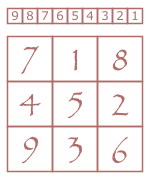 The Lo Shu ordering mixes yin and yang movements together, which adds to the bewildering nature of the starmaze. But labyrinths should be more about contemplation and, ulitimately, clarity.
To achieve this I separated the yin and yang cells, arranging the four lower bits of each location around the four yang points of the compass,
north, east, south, then west, with the fifth bit remaining in the center.
To form the remaing four higher bits, I then used the yin cells in the southeast, northwest, northeast, and finally southwest corners.
The Lo Shu ordering mixes yin and yang movements together, which adds to the bewildering nature of the starmaze. But labyrinths should be more about contemplation and, ulitimately, clarity.
To achieve this I separated the yin and yang cells, arranging the four lower bits of each location around the four yang points of the compass,
north, east, south, then west, with the fifth bit remaining in the center.
To form the remaing four higher bits, I then used the yin cells in the southeast, northwest, northeast, and finally southwest corners.
I did not change the Lo Shu coordinates which determine which edges in the hypercube lead to which rooms. All I did was to reorder the bits to form Styx addresses which are then quietly mapped back to Lo Shu addresses when doing calculations. So the lowest four bits in a Styx address now corrrespond the north, east, south and west yang cells. But choosing those four cells will actually still carry you along the standard Lo Shu 9th, 7th, 1st, and 3rd dimensions.
This may seem confusing, but all you really need to understand is that this ordering causes the labyrinth to snake through one house at time, shift from public to private using the center cell as before, and only then move between houses, first within the four directions of each house type, and then through the four types: first deeps, then courtyards, then bastions, then towers. And this change happens without affecting which rooms connect to which. The only thing that changes is the sequence through which we traverse those rooms.
This system allows me to create a single diagram for the entire labyrinth, arranging the nine-bit locations of each step into a giant ring:
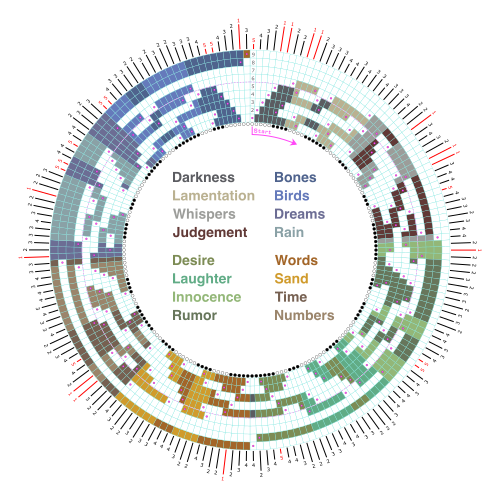
How to Read This Diagram
Each room in the labyrinth is represented as a thin wedge of nine cells, numbered 1 to 9 from the inside out, one cell for each dimension. White cells represent circles; colored cells represent squares. Together they form a nine-bit number representing a particular corner of the hypercube.
There are 186 wedges altogether, starting from the north and moving clockwise until they form a complete ring. The final room returns to the starting point.
Only one of the nine cells in any wedge is open, representing the sole available exit from that room. These cells are marked with pink dots. If you were playing the game, looking at the three-by-three array of circles and squares for each room pattern, the pink dot would correspond to the only cell with a solid circle or square (using the alternative to Lo Shu numbering shown above).
Only one location bit flips each time you take a step. So the cell containing the pink dot will flip in the next wedge; if white (circle), it will become colored (square); colored cells will flip to white.
If you zoom in you may notice a pink dotted line separating the first five yang cells from the final four yin cells. Because of the way the dimemnsions are ordered, changes inside the dotted line will cause movements within the current house; changes above the dotted line will cause movement to a different house. Changes in the fifth cell just within the dotted line, representing the center dimension in the patterns, cause movement from public to private chambers or vice versa. You will recall that each room in the starmaze has an outside public chamber and an inner private chamber leading to the windowless interior part of the maze. Small black and white dots just inside the ring indicate whether you are in the public or private part of the maze; white if public, black if private.
The non-white cells in each wedge, representing squares, are filled with a different color depending on which house you are currently visiting. As shown in the legend within the ring, there are 16 colors for the 16 houses arranged in groups of four:
Movement through the labyrinth proceeds fairly cleanly through these four quadrants: deeps to courtyards to bastions to towers.
As you move through each house, you will move up and down through five levels. Recall that levels in the starmaze are numbered from the top down. Level 1 is at the top of each house, level 5 down at its base. Your current level is shown by the rays extending outside each wedge. Rooms at the top or base are shown in red.
A Walk Through the Labyrinth
With a little practice, you can follow each step through the labyrinth, always knowing where you are in larger context of the starmaze.
After decades, the 3D starmaze has become a memory palace for me, so I feel like I'm really inside the labyrinth when I study this ring diagram.
To test your understanding, here are the first 10 steps:
Step
Pattern
Description
1

Darkness, Rm 16 (Public), Level 5.
We start in what was the pit, the pattern with nine circles, the room of no escape, sealed in rock at the base of the East Deep.
Before, there was a sealed obelisk and 8 slides leading in to the bones of hapless wanderers.
But now, in the Labyrinth of Styx, one of those slides has become a stairway leading up to...
2

Darkness, Rm 15 (Public), Level 4.
The west-facing pier at the base of the east ziggurat. In the distance the other three deeps rise from the dark waters of the grotto.
Overhead, the occulus shines down as a brilliant circle of blue.
A row of empty cockleshell boats attached to an underwater system of gears advance steadily from the House of Judgement to our right;
as each boat arrives, it is pulled under the waves. There is only one way forward: a staircase leading up to...
3

Darkness, Rm 11 (Public), Level 3.
An open platform on the northwest corner. The only slide back down is blocked and all other exits are closed.
The stairway continues wrapping clockwise around the ziggurat, leading up to...
4

Darkness, Rm 4 (Public), Level 2.
An even higher platform on the north face. The only remaining staircase leads straight up to...
5

Darkness, Rm 1 (Public), Level 1.
The top of the House of Darkness, a platform that wraps around the massive shaft of stairways leading up to the surface.
From here we get a spectacular view of the entire grotto and the other three deeps.
All ways down are blocked and all entrances to the interior are closed. Only the obelisk is open now.
We press in on the one-way door and slide down the pole to...
6

Darkness, Rm 1 (Private), Level 1.
The private chamber at the top of the ziggurat, which looks strangely familiar. The pattern, a cross of five squares with four circles in the corners,
marks this room as The Starting Room in the classic starmaze. Before, we would climb up through the obelisk.
But now the only way out is a slide leading down. We light a torch and descend to...
7

Darkness, Rm 3 (Private), Level 2.
Another private chamber. The private half of the starmaze is subterranean and windowless, so the journeys therein are quiet, dark, and disorienting.
We take a right turn and descend down another slide to...
8

Darkness, Rm 10 (Private), Level 3.
A lower private chamber. Private passages are usually lined with bricks. But now the only way out is into a stone cavern with irregular walls.
This passage is very long. It leads down, down, down, then up, up, up. Puffing and panting we finally arrive in...
9

Lamentation, Rm 1 (Private), Level 1.
Yet another private chamber, but with a different feel. All the normal exits are blocked.
The only way out is through the obelisk, which holds a short spiral staircase leading up to...
10

Lamentation, Rm 1 (Public), Level 1.
The uppermost room in the House of Lamentation. We are now on the open platform atop the north deep.
Looking across the grotto we can see the top of the east deep we just came from.
The journey continues for another 176 steps. As you can see from the ring diagram above, the path meanders back and forth through all four deeps, then surfaces in the House of Rumor, and climbs up and down the terraced gardens, eventually visiting all four courtyards. Then, while traveling through subterranean private passages, it drops briefly back into the House of Darkness then pops up into the House of Words in the east bastion. Again, we wind back and forth through all four bastions, finally taking a bridge from Numbers to Time and then a staircase all the way up to top of the west tower. This room, atop the House of Dreams, was the Ending Pattern in the original starmaze.
That ending pattern had eight exits, but the same room in the Labyrinth of Styx has only one. The path continues across the towers, moving back and forth between Dreams and Rain, then to Birds, and finally to Bones, ending at the very top of that east tower. The final two steps are a long descent, first to the middle of the east bastion in the House of Words, then all the way back to the pit at the bottom of the east bastion in the House of Darkness.
Along the way we keep switching from public to private rooms, three steps public, four steps private, etc. There are never fewer than 3 nor more than 11 public steps in a row, never fewer than 3 nor more than 11 private steps in a row. There are an equal number of public and private rooms along the circuit.
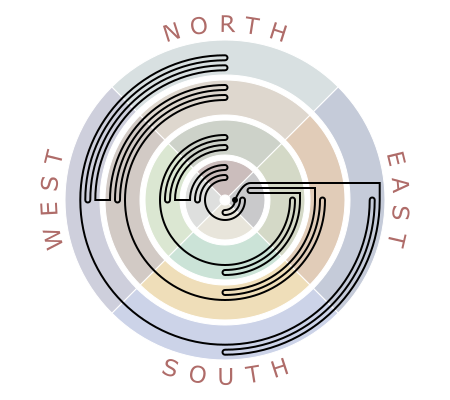
The path also swings back and forth across the four directions of the compass, starting in the east deep of Darkness, moving to the south deep of Lamentation, etc.
It first travels around the inner ring of the deeps, then the courtyards, then the bastions, and finally the towers.
The following directional diagram reveals the ever-winding shape of the labyrinth:
There are some great views along the way, but only from certain houses. The labyrinth includes public views from atop all four deeps, one bastion (Numbers), and three of the four towers (all but Birds). The courtyard of Innocence and the bastion of Words reach level 1, but only through private chambers, so nothing is visible from those rooms.
Of the 32 public and private chambers in each house, only 10 to 14 are part of the labyrinth. Each house is visited two or three times. Most houses are forced to cross to a neighbor after three or four steps, but the four northern houses, Judgement, Rumor, Numbers, and Rain, include continuous runs of 10 chambers in one visit. The breakdown is as follows, sorted by total chambers visited, with individual runs in order of occurrence:
House
Chambers Included
Whispers (West)
10 = 3 + 6 + 1
Innocence (West)
10 = 3 + 3 + 4
Time (West)
10 = 3 + 6 + 1
Dreams (West)
10 = 3 + 3 + 4
Lamentaton (South)
11 = 4 + 7
Laughter (South)
11 = 4 + 7
Sand (South)
11 = 4 + 7
Birds (South)
11 = 4 + 7
Darkness (East)
12 = 8 + 3 + 1
Desire (East)
12 = 3 + 9
Words (East)
12 = 8 + 3 + 1
Bones (East)
12 = 3 + 9
Judgement (North)
13 = 3 + 10
Numbers (North)
13 = 3 + 10
Rumor (North)
14 = 10 + 4
Rain (North)
14 = 10 + 4
As we will see, it is remarkable that so many chambers can join together with only one exit each.
The Surrounding Maze
The Labyrinth of Styx includes 186 chambers. Each chamber defines one outgoing edge to the next step, one incoming edge from the previous step, and seven edges coming in from outside the labyrinth. That's 186 edges within the labyrinth and another 1302 edges leading into it, for a total of 1488. But a 9-cube has 512 corners and 2304 edges. So what's going on with the other 326 chambers and 816 passages?
I originally guessed there might be at least some rooms deep in the maze, not immediately adjacent to the labyrinth. But it turns out that all 326 chambers outside the labyrinth have at least one edge leading directly into the labyrinth. So all of them are on the "shore"; there are no chambers further inland. These shore chambers project all of the 1302 edges leading into the labyrinth. Some have only a single edge leading into the labyrinth, others have up to seven edges leading to different steps. The breakdown is as follows:
Number of Connections
Occurrences
1
12 (3.68%)
2
42 (12.88%)
3
68 (20.86%)
4
82 (25.15%)
5
66 (20.25%)
6
48 (14.72%)
7
8 (2.45%)
The eight shore chambers with 7 connections, chambers almost entirely surrounded by the labyrinth, occur in two of the eastern houses (Bones and Desire) and all four of the northern houses. These are the houses with the longest runs of consecutive chambers; the two east houses have 9-chamber runs, and the four north houses all have 10-chamber runs. Apparently, in order to pull off a long run within a house, you need high-efficiency shore chambers, each feeding an above-average percentage of their edges into the labyrinth.
It may be instructive to look at one of these surrounded shore chambers in the House of Rain. This house, the north tower of the maze, contributes a whopping 14 chambers to the labyrinth, first an epic run of 10 chambers, then, after a brief sojourn in the tower of Dreams, 4 more chambers. All the other 18 chambers in the House of Rain are shore rooms, supplying all those entrances to the labyrinth that leave only one exit for each step. Rain includes not one, but TWO seven-exit shore chambers (c and i, see table below).
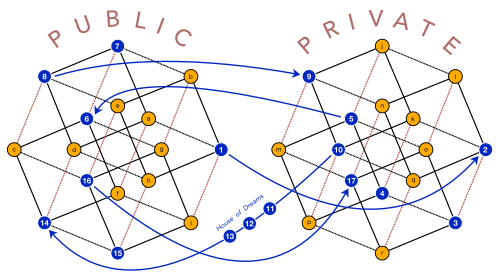
Here the House of Rain has been rendered as two tesseracts, one for its 16 public chambers, the other for its 16 private chambers. The steps of the path through this section of the labyrinth, shown in blue, are numbered from 1 to 17; these correspond to steps 142 through 158 (152 - 154 detour through Dreams).
It's striking how often the labyrinth path switches back and forth between public and private, never staying on one side for more than four steps. In part this is because options to remain on one side quickly evaporate. Every step inside a house forces three or four adjoining chambers to become shore cells if they are not already, making them unavailable as future steps. But in fact, the situation is even more dire: all but two chambers (b and q) are already adjacent to chambers in other houses. By the time the labyrinth enters the House of Rain, the path inside is almost predetermined.
The following table shows the connections from the 18 orange shore chambers to internal or external steps in the labyrinth:
Chamber
Steps Within Rain
Steps in Other Houses
a
1, 7
Rumor, Numbers, Bones
b
1, 7
NONE
c
6, 8, 14, 16
Rumor, Numbers, Bones
d
8, 10, 14
Dreams, Bones
e
8, 16
Rumor, Numbers, Bones
f
4, 6, 14
Rumor, Numbers, Bones
g
6, 16
Rumor, Numbers, Dreams, Bones
h
1, 15
Rumor, Numbers
i
1, 3, 15
Rumor, Numbers, Dreams, Bones
j
5, 7, 9
Numbers, Dreams
k
2, 4, 10
Rumor, Numbers
l
2
Rumor, Numbers, Dreams, Bones
m
5, 9, 17
Rumor, Numbers, Bones
n
9, 17
Rumor, Numbers, Dreams, Bones
o
3, 5, 17
Rumor, Bones
p
4, 10, 14
Rumor, Numbers, Bones
q
2, 10
NONE
r
3, 15, 17
Rumor
Is there any way to pack more than 14 labyrinth steps into a single house? And is it possible to have a run of more than 10 steps?
A path inside a hypercube which never touches itself is what mathematicians call a snake. Finding the longest possible snake in a hypercube of dimension n is called the Snake In The Box problem. A continuous run of a labyrinth through a single house of the starmaze forms just such a snake. A house with its 32 chambers forms a pentaract or 5-cube. And for n = 5, such a snake is known.
In his Master's Thesis, Ananta Palani descibes eight such snakes for a 5-cube. I reconstructed all eight; here is my favorite:
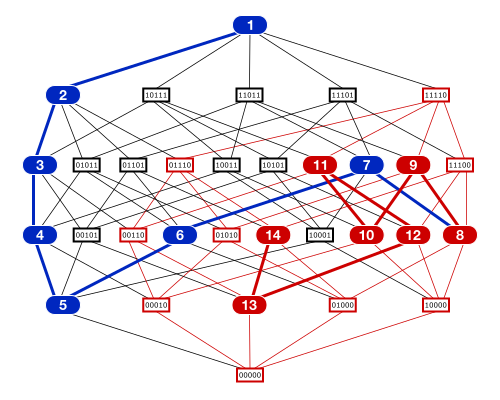
As you can see, this snake visits 14 chambers without ever being adjacent to itself. Here the house is drawn with public chambers in black and private chambers in red. The snake starts at the top, winds through seven public chambers, then passes through an obelisk and traverses seven more private chambers.
This snake winds through a prestine hypercube; the House of Rain, or indeed any house in the Starmaze, is not so lucky. Every step of the labyrinth forces shore chambers to be reserved in four other houses, one for each yin crossing. Rain has four such neighbors: Dreams and Bones to the west and east, Rumor and Numbers on either side below. As the labyrinth passes through those four houses, some chambers within rain are reserved and become unavailable as labyrinth steps. So any snake entering the House of Rain faces an obstacle course. All things considered, it is remarkable that even a run of ten chambers is possbile.
I find it interesting that in a 5-cube, the maxmum possible snake nodes is 14, leaving 18 shore (or "skin") nodes. This is also the maximum distribution within the starmaze, occuring only the houses of Rain and Rumor. There are no 14-chamber runs in the Labyrinth of Styx, but in those two houses the same number of chambers appear broken into two separate runs. Perhaps the 14-step limit on snakes is also a limit on the total number of labyrinth steps a house can host.
If all 16 houses could do as well as Rain and Rumor, this would enable a labyrinth of 224 steps, but I doubt this could ever be possible. The closer a house gets to the maximum number of labyrinth steps, the more chambers it forces in neighboring houses. Rain triggers 52 such shore chambers in other houses, further limiting their options. An assymetric 9D labyrinth has been found with 188 steps, but so far no longer labyrinth is known. Judging from the almost perfect packing in the Labyrinth of Styx, I suspect this may be the upper limit.
On Shore in the House of Rain
The House of Rain forms a penteract with 32 corners and 80 edges. The internal steps within the labyrinth use 12 of these edges. The above table shows that the shore chambers feeding the labyrinth use another 46 internal edges. That leaves 22 edges between shore chambers unassigned; each could flow either way. This means that there are 2^22 = 4,194,304 different ways of connecting the 18 shore chambers in Rain.
Does it really matter how these unassigned edges are directed?
Consider chamber c in the House of Rain. 7 of its 9 edges lead directly into the labyrinth. Of the two remaining edges, one leads through the obelisk to a private chamber, and the other leads to a shore chamber in the House of Dreams. There are four possible ways of orienting these two unassigned edges. If at least one of those two edges lead to neighboring shore chambers, a wanderer who pops into chamber c has a chance of staying on shore. But if both edges lead into chamber c, there will only be 7 exits, all leading to the labyrinth; a wanderer would have no choice but to leave the shore.
So the orientation of unassigned edges does matter. The following map shows one of the four million possible edge orientations just within the House of Rain:

The small black arrows show which way each edge flows. The arrow pointing from chamber r to chamber q indicates that r has an exit to q, but q has no way of directly reaching r (or any of the chambers beyond it). The small number atop each node show how many exits that chamber has to the 14 steps of the labyrinth inside Rain.
This map treats the House of Rain as an isolated unit with only five connections from each chamber instead of nine. So the connections to sections of the labyrinth outside Rain are not counted, nor are movements to shore chambers in other houses. This isolation makes it possible to calculate how long it would take a randomly moving wanderer starting in any of these shore rooms to escape into the labyrinth within Rain.
By assigning movement probabilities to each node, we can create what mathemeticians call an Absorbing Markov Chain. Here "absorbtion" means moving outside the map through one of the possible exits to the enclosed labyrinth. We form a matrix where each (i,j) cell contains the probability of moving from node i to node j. For example, node a has four exits; one to d, one to f, and two to the labyrinth. So (a,d) and (a,f) both equal .25.
To calculate the expected number of steps needed to move from node x to node y, we subtract our matrix from the identity matric and invert it. In this case our matrix is 18 x 18. We can then sum the values in each row to calculate the expected absorbtion time statring from each node. I have assigned a range of colors for each node based on these row sums.
The colors tell us that the less connected a chamber is, the sooner it will lead a wanderer into the labyrinth. Chamber c, with four exits to the labyrinth and only one to another shore room, is the least connected. Chamber l, with three shore exits and only one laybrinth exit is the most connected; it takes a little longer to escape starting from chamber l. But the escape times are all fairly quick since most chambers have more labyrinth exits than shore exits. Movement entirely within Rain is like flipping a heads-weighted coin until you get heads - it won't take long.
Beyond the House of Rain
For the maze as a whole the possibilities are far more vast. A 9-cube has 2304 edges. The labyrinth consumes 186 of these, the edges feeding in from the shore consume another 1302. This leaves 816 edges unassigned. 2 ^ 816 equals
| 4, 369, 949, 940, 022, 946, 808, 131, 310, 210, 035, 463, 735, 011, 048, 111, 260, 268, |
| 790, 836, 336, 787, 034, 166, 666, 801, 725, 231, 985, 827, 249, 045, 958, 843, 891, 950, |
| 919, 251, 878, 054, 657, 305, 671, 438, 831, 881, 343, 903, 110, 121, 555, 873, 995 |
| 959, 795, 042, 912, 242, 504, 500, 249, 076, 464, 121, 981, 819, 957, 006, 128, 303, 830, |
| 683, 235, 920, 019, 285, 422, 143, 847, 159, 850, 223, 710, 958, 661, 424, 960, 677, |
| 935, 273, 205, 096 |
This is more than the number of atoms in the universe, more than if each of those atoms held its own universe of atoms, more even than if all of THOSE atoms were universes.
In other words, there are an unfathomable number of configurations for the maze surrounding the Labyrinth of Styx. And yet, we do not have to leave this to chance. By using deterministic rules instead of flipping coins, it is possible to design this maze, at least to some extent.
There are many alternatives.
- We could tilt shore crossings so that all crossings from male houses exited to female houses. This would mean that if you started in a male shore chamber you would either enter the labyrinth or cross to a female shore chamber, and once there you would not leave that female house until you entered the labyrinth.
- Similarly, we could ensure that all shore transitions through the obelisk always led from public chambers to private chambers. This would mean that every public obelisk would lead either directly to the labyrinth or to the private part of the maze, and once in the private maze you would never emerge into the sunshine until after you entered the labyrinth.
- We could try to maximize the number of four-step cycles. Or eliminate all cycles.
- We could allow some shore chambers with no exits ashore, forcing visitors immediately into the labyrinth. If we could define a subset of shore chambers that were the only ones feeding such forced exits, we might be able to fracture the maze into distinct regions.
- Or we could create shore chambers with nothing but exits, making them source rooms that could never be visited more than once while reducing onshore options for the remaining shore chambers. How many such chambers could we make before running out of exits?
- Conversely, we could give shore chambers a balanced number of exits and entrances, guaranteeing at least one entrance and one exit to another shore room. This would create a fully-connected maze that would probably contain enough cycles to keep wanderers in the maze a litle longer.
This last design was my first instinct: one unified maze surrounding the labyrinth, a maze with many choices. How could we make it and what could we learn about it?
The Initial Design
I began by assigning unique numbers each of the 326 shore chambers. To do this I sorted them in the same order I used for the House of Rain:
Orderings like this create unique IDs. Just list the chambers in this order and number them 1 to 326. With these ID numbers I made a table of all the shore IDs and, for each, the count of its unassigned edges (edges not leading into the labyrinth). I also made a table of the unassigned edges listing the shore IDs at either end.
Using both tables I sorted the first table, took the shore ID with the fewest unassigned edges, then choose directions for each edge so that there would be about the same number of shore exits and shore entrances for each. Even in the most extreme cases, this guarantees that every shore chamber has at least one exit and at least one entrance to the rest of the shore.
I then resorted and repeated until all shore chambers were resolved. Both the labyrinth and the maze were now completely mapped.
The final step was a Markov analysis, like the one I did above for the House of Rain, but this time for the entire shore. This required me to invert a 326 x 326 matrix with over 100,000 entries - which I did with all values accurate to at least 12 decimal places.
So what do we learn from all this?
We learn that a single, unified shore maze surrounding the labyrinth with balanced exits and entrances is not - and could never be - as fearsome as I had imagined.
When I first conceived the Labyrinth of Styx, I thought wanderers plopped into some random chamber of the maze might wander for many days before finally stumbling into the inner labyrinth. But, just as with the House of Rain, this was not the case. Since each chamber in the maze has at least one - and as many as seven - exits into the labyrinth, it doesn't take long before a wanderer chooses one of those exits.
The expected number of movements required to escape the maze varies from 1.156 to only 2.435. So on average, a wanderer will escape within just two or three moves.
I did verify that my design achieved its goal of full connectivity. From any shore chamber it is always possible to reach any other shore chamber.
I also counted the number of cycles: there are 84, with some chambers participating in as many as four different cycles. This is far short of the maximum 2560 possible for a 9-cube, or even the 512 cycles present in the classic starmaze, but proabably about as many as you could get given that more than half the edges were already taken. My analysis showed that cycles do not ensure dramatically longer escape times, though they do allow at least the possibility of indefinitely long stays.
So in theory, you could wander there for a thousand moves without ever escaping to the labyrinth. But in practice, this is about as likely as flipping one thousand coins without ever once getting heads.
And this is true for any possible design of the maze. Even if we maximized the number of shore chambers with nothing but exits, fracturing the maze, we might widen the range of expected steps, but only slightly. Every exit we create also creates an entrance somewhere else, so a rough balance is preserved no matter what.
The maze is leaky. It constantly leaks into the labyrinth.
In retrospect, this should have been obvious. A short labyrinth would allow a bigger maze with some chambers further inland - high and dry. A maze like that could indeed trap wanderers for a much longer time. But the larger the labyrinth, the smaller the maze, until there are no inland chambers. And the Labyrinth of Styx, by design, is almost as large as we could possibly make it.
All of this made me question my initial design. If the maze could not be fearsome, what other qualities could it have? And how should I choose?
This last question is fundamental. It's a question familiar to me as an artist. When there are many options, how do you choose?
This was never an issue with the original starmaze. It came to me as a miraculous crystal, endlessly fascinating, something full of details to discover - not invent. But the Labyrinth of Styx is different. It is my first attempt to define a completely independent hypercube puzzle. And as we have seen, its pursuit requires choices, with each choice leading to more choices.
As an artist I seek to find the essence of any creation, distill that essence, savour it, and use that understanding to discover its true nature. Like a sculptor, I hunt for the true form inside the marble.
So what is the true form of the Labyrinth of Styx?
Thinking about it in this way I realized that my first instinct was to make a counterpoint to the labyrinth, a maze that would stand in contrast to the labyrinth it enclosed. But this was wrong. It would be better to make the maze in the same spirit as the labyrinth, a place of inevitiablity, a place of simplicity, a shadow of the labyrinth, not a complement.
And once I had this insight, I saw a very simple way of accomplishing it.
The Shadow Maze
Forget the complex algorithms. For each edge connecting chambers A and B, always make the lower ID number lead to the larger ID number. Just follow the defined order of the shore chambers. That's it.
This simple rule has many consequences, including many of the alternatives mentioned above.
- The shore IDs always increase, just as the steps in the labyrinth do. This means that cycles within the maze are impossible.
- The absence of cycles means that indefinite stays are no longer possible. The maze marches relentlessly to the labyrinth and, regardless of choices, will always sweep a wanderer into that labyrinth within a fixed number of moves. The longest such path is shown below.
- The maze is not fully connected. Once you leave any shore chamber, you can never return to it.
- Shore chambers are no longer guaranteed at least one shore exit and at least one shore entrance. In fact, there are 11 chambers that have nothing but exits, either to the maze or to the labyrinth. I call these chambers "springs".
- And there are 16 chambers that have only exits to the labyrinth with no exits to the maze. These are forced exits. Once you arrive at any forced exit chamber in the maze, the next exit you take will place you somewhere in the labytinth.
- Crossings in the maze from one house to another relentlessly follow the order in which houses are first encountered in the labyrinth. The labyrinth sometimes meanders back temporarily to a previously visited house, but the maze does not. Crossings to other houses may jump ahead, but can never move back. The lowest numbered chambers in the maze start in the House of Darkness and move forward. Once a maze wanderer leaves the House of Darkness she can never return to that house until she is in the labyrinth. And so it is with every other house in the maze.
- As a consequence, wanderers in the maze are guaranteed to reach the labyrinth within one full circle. Once in the labytinth you will continue in that circle forever, but your journey in the maze will be complete before the first circle is complete. And if you enter the maze in the Tower of Bones, the final house visited by the labyrinth, you will be forced into the labyrinth before seeing any other house.
- Similarly, the maze always moves through obelisks from public to private chambers, never the other way. So in the maze, once you pass through any obelisk, you will either enter the labyrinth immediately, or remain wandering through the maze in darkness until you do.
- And whether in public or private chambers, motion within any house in the maze is always downhill. You will always move toward the bottom of a house until you either enter the labyrinth, or cross to another house farther along in the circle. The only way to ever move upwards is if the crossing carries you to a higher chamber in the next house.
The maze, then, shares the essential qualites of the labyrinth it encloses. While it seems to offer multiple choices at each step, in fact these choices only delay the inevitable descent.
The maze is like a series of tributaries flowing into the sea. It starts from one of 11 springs and then flows steadily downhill, forming a confusing delta along the way. Its branches sweep out in different directions, which then branch even further, but many of those branches rejoin neighboring tributaries. They interweave with each other, while also continually leaking into the labyrinth, but always move downhill, until a final joining with the labyrinth is no longer a choice.
It's hard to map such a bewildering set of intertwined triburaries, but we can get a feel for its shape by focusing on just one spring, the highest and first spring, which starts from shore chamber 1.
The delta flowing from this one spring is still a hopeless tangle. But we can peer inside that tangle by doing a depth-first search and then only drawing its intial branchings and sub-branchings, while hiding all branches which lead to chambers already drawn. The result is a "depth-first hierarchy" which can be drawn cleanly without any crossing lines. It's not a complete map, and different search orders would produce different hierarchies, but it does reveal an order beneath the chaos.
This view of the delta looks like this:
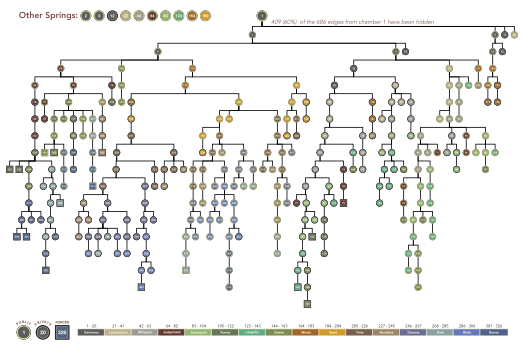
As complex as it is, this diagram only shows about 40% of the 686 edges which descend from shore chamber 1; the other 409 redundant edges are not shown. Nor are the many edges leaking into the labyrinth at each step.
And this is the delta from just one of the eleven springs. It is the second largest, with a total of 277 chambers. The delta from shore chamber 2, which starts from an adjoing room just below the top of Darkness, is slightly larger with 284 chambers and 699 total edges. It shares the massive chamber 4 subtree; its only difference is a chamber 6 sub-tree on the far-right slightly larger than the chamber 5 sub-tree in our diagram.
The other springs share many of these chambers, but also flow to 49 other chambers not included here. Four of those springs (64, 83, 123, and 164) start from great views at the top of houses unreachable from the House of Darkness. These later deltas are not as big, since they encompass fewer and fewer houses, but the output of 164 has a surprise. Despite having only 157 chambers it somehow contains a 20-step path, longer than any path not originating in the House of Darkness. The maze is full of surprises like this.
As the key at the bottom illustrates, public chambers are enclosed in light yellow rings to represent daylight; private chambers are enclosed in dark rings. Forced exit chambers are shown as squares instead of circles; all 16 of them appear in this delta.
Each chamber is colored to indicate its house; the key shows house colors in maze order from left to right. If you have trouble discerning the color of a particular chamber, find its chamber ID in the ranges above each color in the key.
By zooming into this diagram, you can follow any one its myriad descents. You can see the moment when a wanderer descends into darkness through an obelisk, leaving the rings of sunshine behind. You can see the crossings from one house to another, the colors changing with each jump.
The longest visible journey in this hierarchy has an impressive descent of 18 steps. Yet this is not the longest possible walk through the maze, or even the longest in this delta. Some of the hidden redundant edges reach upwards into neighboring subtrees and form 22-step paths. 22 steps is the longest journey you can take anywhere in the maze before falling into the labyrinth.
A slightly shorter journey appears near the left edge: the journey from the first shore chamber (1) to the last (326). To make this more vivid, and to see the actual patterns facing you at each step, I list it here:
A Walk Through the Maze
This alpha-omega journey has 16 steps.
Each step is numbered, with a pattern and starmaze room description.
To each description I prepend the shore chamber ID number from the diagram, abbreviated as Sc.
The patterns are unmarked, but the description indicates which cell leads to the next step.
Step
Pattern
Description
1

Sc 1 - Darkness, Rm 2 (Public), Level 2.
We start in a public chamber on the east-facing terrace just below the top of the House of Darkness.
All shapes in the pattern are filled (open), indicating that we can take any of the nine exits;
this is true of all eleven springs in the maze. Five exits lead to different steps in the labyrinth;
four lead deeper into the maze. We choose the east yang cell, a slide leading down to...
2

Sc 4 - Darkness, Rm 6 (Public), Level 3.
A lower platform on the northeast corner of the ziggurat.
Only one of the seven exits lead into the labyrinth. This time we choose the west yang cell
which curves back to our left and down to...
3

Sc 8 - Darkness, Rm 12 (Public), Level 4.
The northwest pier at the base of the Darkness ziggurat.
A line of automated cockleshell boats rise from the waters of the grotto and curve south to the eastern pier of the House of Lamentation.
We could board one of these boats, but it would carry us to the labyrinth,
as would the only remainging slide down to the pit (which is where the labyrinth starts).
Of the four remaining exits, three lead deeper into the maze; we choose one of these,
the northwest yin cell which leads to a tunnel underneath the grotto and then up to...
4

Sc 65 - Judgement, Rm 3 (Public), Level 2.
The eastern terrace near the top of House of Judgement.
We now have many choices, four leading to the labyrinth and three further into the maze.
We choose the western yang cell which carries us straight down to...
5

Sc 69 - Judgement, Rm 9 (Public), Level 3.
The eastern platform just below the terrace.
We once again have seven choices, but this time all but one lead to labyrinth.
The only remaining opening to the maze is via the central cell through the obelisk.
So we take one last look at the grotto and the sun shining through the occulus overhead,
open the door on the obelisk, and slide down the pole to...
6

Sc 78 - Judgement, Rm 9 (Private), Level 3.
The private chamber below the eastern platform. We are in total darkness now, so light our torch.
As it turns out, five of the remaining six exits lead to labyrinth,
so we choose the north yang cell which leads down to...
7

Sc 80 - Judgement, Rm 12 (Private), Level 4.
A chamber beneath the northwest pier. This chamber contains something only three private chambers have: a window -
a thick glass window with a murky view of the grotto below the waterline. A mournful, pale green fish swims past.
Again, only one of the six exits lets us linger in the maze, the south yang cell leading down to...
8

Sc 82 - Judgement, Rm 16 (Private), Level 5.
The final private chamber at the very bottom of the House of Judgement.
We can no longer stay in Judgement or any other deep;
the only exit not leading to the labyrinth, corresponding to the northeast yin cell,
takes us through hidden stairways up, up, up into...
9

Sc 119 - Rumor, Rm 11 (Private), Level 3.
A chamber beneath the third eastern terrace in the east wing of the gardens of the House of Rumor.
Just above our heads we can hear the sound of water being channeled from waterfalls in the Tower of Rain into the gardens.
We finally have more choices that will keep us in the maze: four of the six exits.
We choose one of these, the southwest yin cell, which leads up, up, up to...
10

Sc 277 - Rain, Rm 1 (Private), Level 1.
A chamber just below the summit of the House of Rain. Too bad we can't see the spectacular view just above us,
but that view is step 148 of the labyrinth.
So although the obelisk in the central cell is open to us here, we cannot take it and stay in the maze.
Three of the other exits will keep us in the maze; we choose the south yang cell which slides down to...
11

Sc 279 - Rain, Rm 5 (Private), Level 2.
A chamber under the south-facing terrace in the Tower of Rain.
Two of the remaining three yang cells keep us in the maze, both leading down to the next level.
We choose the north yang cell which slides us down to...
12

Sc 281 - Rain, Rm 8 (Private), Level 3.
 The chamber just below the upper section of the inner tower in the center of the Tower of Rain.
Other than the obelisk above (an earlier part the maze which only opens downward),
there are only two narrow bridges leading in or out of this chamber.
We came in through one of those bridges; the other leads to seven more exits.
Only one of those seven keeps us in the maze: the west yang cell.
This (eventually) leads to...
The chamber just below the upper section of the inner tower in the center of the Tower of Rain.
Other than the obelisk above (an earlier part the maze which only opens downward),
there are only two narrow bridges leading in or out of this chamber.
We came in through one of those bridges; the other leads to seven more exits.
Only one of those seven keeps us in the maze: the west yang cell.
This (eventually) leads to...
13

Sc 284 - Rain, Rm 14 (Private), Level 4.
A chamber below the western balcony farther down in the House of Rain.
Another great view above us, but only darkness below where we are, so we really have no idea where we are.
Of the four available exits here, two lead to the labyrinth, and the other two stay in the maze.
We take one of these, the east yang cell, which leads us even further down to...
14

Sc 285 - Rain, Rm 16 (Private), Level 5.
The chamber below the base of the inner tower, as low as we can go in the Tower of Rain.
We have no choice but leave this tower and find another one. The restrictions of the maze
allow only two remaining houses, Birds and Bones, and only one of the five exits keep us in the maze.
We therefor choose the northwest yin cell which carries us through one of the great tower bridges to...
15

Sc 323 - Bones, Rm 10 (Private), Level 3.
A chamber beneath the southwest corner room halfway up the final tower in the maze, the House of Bones.
Of the three remaining yang exits, one leads to the labyrinth, the others below the south and west balconies.
Either one will do, but the final stop visible in our hierarchy diagram above is the one behind
the west yang cell, which leads to...
16

Sc 326 - Bones, Rm 15 (Private), Level 4.
The last chamber in the maze, below the western balcony near the base of the House of Bones.
There are six exits from this chamber, but all six lead to the labyrinth.
Whichever exit we choose, it will be immediately obvious that we are in the labyrinth, because the next
pattern we see will have only one exit. And the next after that, and the next after that, forever more.
We will land on one of six steps along the labyrinth circle:
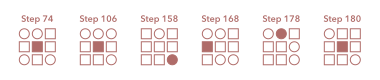
As we have seen, patterns in Styx behave quite differently than they do in the classic starmaze.
Patterns
A 9-D hypercube puzzle pattern represents a room with 9 doors. It has two components: shapes and colors. The shapes, circles or squares, convey the location of the room on a corner of the hypercube as a 9-bit address of 0's (circles) and 1's (squares). The colors, empty or filled, convey the state of each door to an edge projecting from that corner: empty for a closed, incoming door, filled for an open, outgoing door.
If you look closely at the arrangement of circles and squares defining the room's corner in the hypercube, you will find they behave just as they do in the classic starmaze. Each time you choose a cell, that cell flips from circle to square or square to circle, while the other shapes remain as they were. And these arrangements are the same used for each room in the classic starmaze, so all 512 arrangements are used.
What changes, dramatically, is the pattern of filled vs empty colors which define your choices at each step.
In the starmaze, these changes were consistent and predictable. They seemed to follow fixed rules. You can only click filled cells and clicking a cell always flips it to empty in the next pattern. Clicking a compass yang cell flips the coloring of its two adjacent corner yin cells in the next pattern, etc.
The first of these rules still holds in the maze of Styx. You still can only click filled shapes, and those shapes become empty so that you can never choose the same cell (dimension) twice in a row. But after that, chaos reigns. The empty/filled state of the other eight cells change in ways that seem random.
Another key difference from the classic starmaze is coverage. Coverage is the number of unique color arrangments that occur compared to the maximum possible of 512. The starmaze has 100% coverage. Each starmaze pattern has a unique arrangement of filled and unfilled colors - 512 arrangements in all.
The Labyrinth of Styx has only 32.6% coverage. Some color arrangements occur in more than one location; many never occur. The starmaze has one source pattern (all exits) and one pit (no exits). Styx has eleven identical source patterns and, since maze patterns have multiple openings and labyrinth patterns always one, it has no pit pattern.
Of all the 502 possible arrangements with at least two exit cells, only 158 occur in the maze. And the labyrinth is even worse. The nine possible arrangements with only one exit cell are used again and again over its 186 steps.
Are these patterns as random as they look, or do they follow at least some perceptible rules?
The center cell is fairly well behaved.
Chambers in the maze always flow from public to private. And any edge joining a maze chamber to a labyrinth chamber always flows to the labyrinth. So if you are in the public part of the maze, the center cell will always be open. You can't tell whether that opening leads to labyrinth or further into the maze, but either way it's guaranteed to be open (as you can see in the above walk).
As soon as you transition through the obelisk to the private part of the maze, the reverse is true. The center cell will always be closed unless the center edge touches the labyrinth. So in the private maze, the center cell may randomly switch between open and closed, but if it is open you will know that it leads to the labyrinth.
The four yang cells are somewhat predictable.
As in the classic starmaze, each of the four yang dimensions can only be used once within a given house. If you are at the top of a house, all four will be open; each time you choose one it will stay closed until you leave the house. When all four yang cells are closed you must pass through the obelisk or cross to another house.
In theory, this is also true for yang cells within a house in the Styx maze. In the above walk you can see that the descent from the top of Rain to the bottom moves south, then north, then west, then east. But sometimes other untouched yang cells close, and sometimes yang cells that were closed reopen. What is going on?
Whenever this happens you can be sure the labyrinth is at work.
If an untouched yang cell closes during an in-house descent, it must have been previously open to the labyrinth, not to the maze.
This happens in the first two steps of our walk. In step 1 all four yang cells are open; in step 2 when we choose the east yang cell, the north cell closes as well. But in step 1 we are not atop the House of Darkenss; we are on level 2. So the north yang must have already been used. It was open only because the north edge was touching the labyrinth. Moving to step 2 revealed the state it would have had - closed - and it remains closed until we leave Darkness.
The same is true for yang cells that reopen. In steps 10 - 12 of our descent through Rain, we first choose the south cell, then the north. At that point the south cell reopens. This must be because that south edge has made contact with the labyrinth.
We could make similar observations about the yin cells.
The take-away is that the labyrinth has an unpredictable effect on openings in the maze. It winds through the hypercube in a particular way and as we move through the maze different edges come into contact with it. Whenever this happens, the normal color changes are disrupted. We can sometines use this understanding to identify cells which must lead to the labyrinth, but the color patterns themselves remain chaotic.
There are 345 color arrangements that never occur in Styx. Can we tell an impossible pattern just by looking at it?
Here are all of those impossible patterns, sorted by number of exits.
The cell shapes are squircles instead of squares and circles, since none of these patterns have locations on the hypercube:
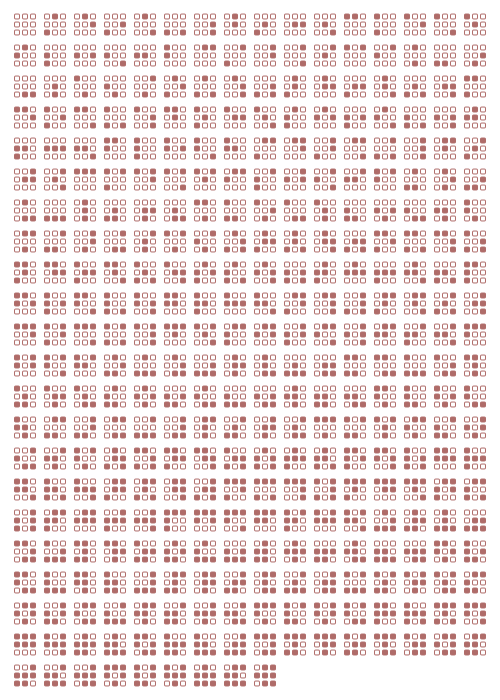
About half of these patterns have only two or three openings - which means such patterns in the actual maze must be rare. In fact the maze has NO arrangements with only two exits, and only two with three exits: 321 (two labyrinths and one shore) and 323 (one labyrinth and two shores). Chamber 323 occured near the end of our walk.
Other than that, I couldn't see any obvious indicators of an impossible pattern. On average, there are 5.84 exits in a shore chamber, noticeably more than the 4.5 average in the classic starmaze. The maze offers many choices and its patterns are mysterious.
Having now taken many mental walks through this maze, I am satisfied with the way it turned out. The way the maze flows relentlessly and irreversibliy into the labyrinth feels right to me. And with the maze fully mapped, I can now calculate the expected escape time from each shore chamber.
My intial balanced design for the maze had a Markov escape time varying from 1.156 to 2.435. The same analysis for the final design has a slightly wider range, varying from 1 to 2.472. The 16 forced exit chambers all have an expected escape time of 1 move - the mandatory move directly into the labyrinth. The chamber farthest from the labyrinth is not one of the springs (each of which has multiple direct leaks to the labyrinth), but shore chamber 4, which leads to most of the chambers in the maze but only has one direct leak.
The harsh truth remains, however. Unless you have a map, as I did in the walk above, chances are you will stumble into the labyrinth within just two or three moves.
The Key to the Labyrinth
The Labyrinth of Styx is a hypercube puzzle, as described on my Puzzle Keys page. Now that it is fully mapped, I can create its key and add it the list of keys at the bottom of that page. The key is simply a 2304 bit binary pattern describing the direction of flow for each of the 2304 edges in a 9-cube. It is this direction of flow which defines the behavior of any hypercube puzzle.
Using the same technique of arranging by dimensions and coding 0 bits as white and 1 bits as black, the key to the Labyrinth of Styx looks like this:

As was done on the Puzzles Keys page, we can isolate each dimension and draw it as series of concentric circles. When this was done for the starmaze, the results were astonishing: each dimension had a hightly symmetrical but distinct pattern. When the same thing is done for the Labyrinth of Styx, the results are far more random:

In the key shown above, the dimensions are in standard Lo Shu order so that it may be compared with keys from other hypercube puzzles. But in the circle diagram I have replaced the dimension numbers at the center of each circle with the ordering used in Styx. So the north circle, dimension 1 in Styx, as shown in the 9th section in the key. The east circle, 2 in Styx, is actually 7 in the standard order. And so forth.
I have also added the percentage of filled segments for each circle. In the classic starmaze this value was exactly 50% for all nine circles. In Styx that is only true for dimensions 2 and 3, which along with 1 and 4 control movement within houses. The other percentages show a notable imbalance, especially in dimensons 5, 6, 8, and 9. Why might this be?
For the purpose of the keys, a segment is filled for any edge in which a 0 coordinate leads to a 1 coordinate (for that dimension). In the starmaze, every 0 to 1 edge is balanced by a 1 to 0 edge somewhere else for all nine dimensions.
For the 186 edges used for the actual labyrinth at the center of Styx, the edges would also be balanced. If you scroll back up to the ring diagram and look at the pink dots showing dimension flips, you will see that each time a pink dot appears in an empty wedge (circle moving to square) its next occurence is always in a filled wedge (square moving to circle). This is a consequence of the labyrinth being a hamiltonian cycle that returns to its starting point.
Some dimensions are used more often than others, however:
Dimension
Total Steps
Percentage
1
28
15.05%
2
32
17.20%
3
22
11.83%
4
28
15.05%
5
38
20.43%
6
28
15.05%
7
4
2.15%
8
4
2.15%
9
2
1.08%
The larger values in lower dimensions is a consequence of the way the labyrinth winds through the hypercube. Most movement takes place within houses, with directional crossings coming less often and crossings to different house types coming only about once per quadrant. For some reason movements through the obelisk from public to private or back come more often than any other kind of movement.
Nevertheless, the ratio of edge directions is balanced for every dimension in the labyrinth. Is this balance maintained in the 1302 edges feeding in from the maze?
Each step of the labyrinth has 7 edges coming from the maze, one for each unused dimension. And since each dimension in the labyrinth has the same number of circles (0's) and squares (1's), exactly half of the incoming edges for any dimension will arrive at a 1 coordinate (resulting in a filled segment). So if the shore chambers were evenly distributed in the hypercube, the edges feeding it should also be close to balanced.
Are shore chambers evenly distributed? Not quite. The chance of a coordinate being 0 and causing a filled segment for a given dimension of a shore chamber is not always 50%.
This may partly explain the relatively few filled segments in circle 6 above and the above average filled segments in circle 1. As for the rest, the higher the dimension number, the fewer edges there are belonging to the balanced labyrinth. A higher proportion of edges coming from the maze provide a greater opportunity to disrupt that balance; this is surely a factor in the extra filled segments in circles 8 and 9 above.
The 816 remaining edges connecting shore chambers do make one very clear contribution. Movement within the maze through an obelisk always moves from public to private. This creates a significant bias towards 0-to-1 edges.
The dimension 5 coordinate for public rooms is always 0, so all obelisk moves from public chambers that stay in the maze are 0-to-1. The remaining public obelisk moves that leak into the labyrinth are also 0-to-1. The number of those leaks = private steps (186/2 = 93) minus steps entering or leaving an obelisk (38) = 55.
Number of 0-to-1 edges for dimension 5:
- 19 of the 38 obelisk moves in the labyrinth
- 108 of the 163 public shore obelisk moves that stay in the maze
- 55 of the 163 public shore obelisk moves feeding the labyrinth
- TOTAL = 182 or 71.09% of the dimension 5 edges - which matches the total shown in the circles above
As we saw in the behavior of pattern colors, the relative order of the labyrinth is distupted by the asymmetries of the maze. The effects are complex but can be teased out with patient analysis.
Since I first discovered the remarkable nine circles for the starmaze key, I have often wondered just how unusual they were. It's exciting to finally see and compare circles for a different hypercube puzzle. The close analysis of its key and circles has also taught me how to make such comparisons, even when dimensions are reordered.
By finding the key to our labyrinth, we have seen how hypercube puzzles work and how the original starmaze can be changed. Many more such puzzles are now open for discovery.
Other Labyrinths
Many other labyrinths are possible. Different coils could be used to form the labyrinth itself. Smaller labyrinths would allow inland shore chambers which could hold wanderers longer. Much smaller coils would allow mutliple labyrinths separated by a maze the could empty into any of them. The order of shore ID assignments could be changed, resulting in different restrictions within the maze.The algorithm for determining edge directions could also be modified, though I think the concept of a "shadow maze", a maze which follows characteristics of the labyrinth and moves relentlessly downwards into the labyrinth, should not be lightly abandoned.
Other dimensional reorderings could be tried. A labyrinth which respected the original Lo Shu ordering would intermix in-house moves and crossings to explore the maze by constantly changing houses.
Or the very notion of what a labyrinth is could be broadened.
We cannot have a true labyrinth that encompasses all 512 rooms, but we can have a different kind of labyrinth: a labyrinth of memory. As we traverse our grand tour, tracing squares, then cubes, then tesseracts, we can assign a direction to any unused edge we encounter. If we always point them downwards, that is, from higher dimensional rooms to lower dimensional rooms, then every false turn will always lead to the past, to rooms we have already visited.
In the labyrinth of memory, whenever you enter a room with more than one exit, only one exit will be the true path forward. Every other exit is a memory. Following a memory takes you back to somewhere you've been before. The only way to return to the true path is to then relive the steps between then and now.
The Labyrinth of Styx is a true labyrinth hidden inside a larger maze of tributaries. The Labyrinth of Memory would be a maze of choices: ever to move forward or look back, with a labyrinth hidden inside the forward choices.
The End
Thank you for making it all the way to end of this very long page. The journey we have both taken is not just a description of the Labyrinth of Styx, it is a record of how this labyrinth was discovered.
When I started this page there was no such thing as the Labyrinth of Styx. There was only an idle question: was a labyrinth in a hypercube even possible?
One question led to another. My original plan was to investigate the Labyrinth of Memory, which is not a true labyrinth. Styx started out as a footnote admitting that maybe there was one way to make a true labyrinth. That footnote grew and grew until any other labyrinth seemed beside the point.
Along the way, question by question, walk by walk, diagram by diagram, the Labyrinth of Styx became real.
P.S. The Styx Directory contains descriptions of the entire labyrinth and maze with links to ineractive patterns that you can click to experience this puzzle directly.